Retatrutide Peptide: Research Guide
Retatrutide is an investigational peptide-based molecule that activates the GIP, GLP-1, and glucagon receptors. It is being evaluated in clinical research and is not currently approved by the FDA or available for public use.
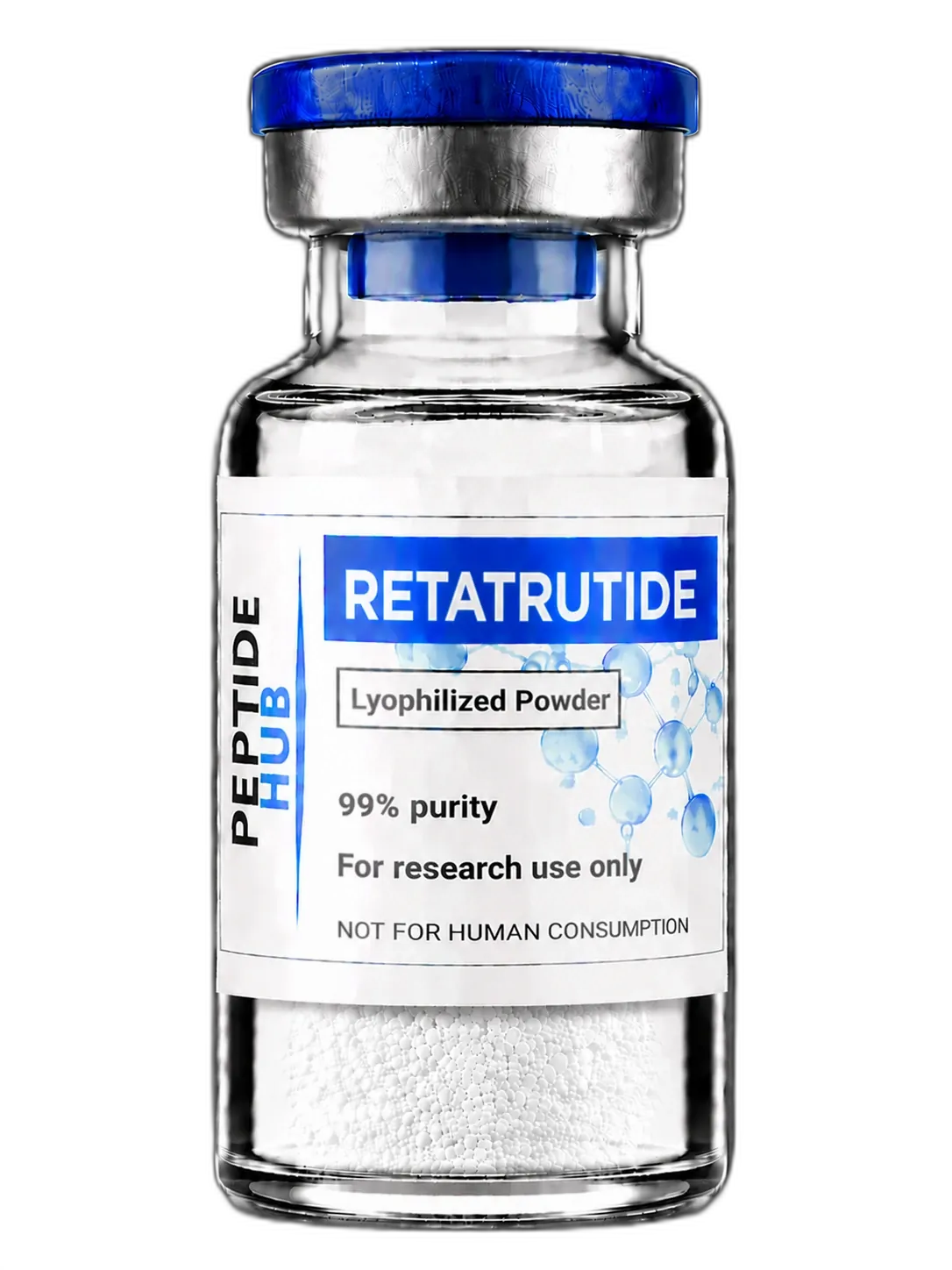
Retatrutide Reference Standard
Lyophilized solid for in-vitro analytical research & HPLC reference.
Guide Contents & Research Topics
What Is Retatrutide Peptide?
Direct Definition: Retatrutide is an investigational synthetic 39-amino-acid peptide engineered as a unimolecular triple agonist targeting the GIP, GLP-1, and glucagon (GCG) receptors.
Originally developed under the laboratory code LY3437943 by Eli Lilly and Company, retatrutide represents a major advance in multi-receptor peptide pharmacology. While traditional metabolic peptides engage single receptors (e.g., semaglutide targeting GLP-1) or dual receptors (e.g., tirzepatide targeting GIP and GLP-1), retatrutide is the first clinically advanced peptide to simultaneously coordinate activity across three distinct metabolic G-protein coupled receptors.
The molecular architecture of retatrutide incorporates an alpha-aminoisobutyric acid (Aib) stabilization motif and an octadecanedioic acid (C18) diacid side-chain linked at lysine position 17. This structural modification facilitates reversible non-covalent binding to circulating serum albumin, extending its pharmacokinetic half-life to approximately 6 days in human pharmacokinetic studies.
What Receptors Does Retatrutide Target?
Direct Answer: Retatrutide targets three biological receptor systems: the GIP (glucose-dependent insulinotropic polypeptide) receptor, the GLP-1 (glucagon-like peptide-1) receptor, and the glucagon (GCG) receptor.
In in-vitro cell assay profiling, retatrutide demonstrates potent, balanced potency across human cloned receptors:
Figure 1: Retatrutide Triple Agonist Receptor Engagement
1. GIP Receptor
High-affinity engagement at the GIP receptor enhances glucose-dependent insulin secretion, improves adipose tissue lipid buffering, and moderates glucagon-induced sensations.
2. GLP-1 Receptor
Potent agonism at the GLP-1 receptor modulates central hypothalamic hunger circuitry, slows gastric emptying rates, and suppresses postprandial glucose surges.
3. Glucagon Receptor
Selective glucagon receptor co-agonism elevates basal energy expenditure, promotes mitochondrial fatty acid oxidation in hepatocytes, and aids hepatic lipid reduction.
What Is LY3437943?
Direct Answer: LY3437943 is the laboratory development code assigned by Eli Lilly and Company to identify retatrutide during early preclinical drug design, pharmacology characterization, and Phase 1–3 clinical registration trials.
In early chemical filings and patent disclosures (such as WO2020081594A1), LY3437943 is identified as a substituted peptide analogue derived from the native glucagon sequence. Chemical modifications at specific residues were introduced to optimize solubility, prevent enzymatic degradation by dipeptidyl peptidase-4 (DPP-4), and ensure balanced receptor activation without causing hyperglycemic side effects from glucagon action.
What Does Triple Agonist Mean in Retatrutide Research?
Direct Answer: In retatrutide research, "triple agonist" describes a single molecule possessing intrinsic agonist efficacy at three distinct biological receptors: GIP, GLP-1, and glucagon.
Historically, pharmaceutical researchers combined multiple separate compounds to target distinct metabolic pathways. A unimolecular multi-agonist like retatrutide offers homogeneous pharmacokinetics, eliminating the complex absorption and clearance differences of co-administered formulations. In research models, the simultaneous activation of GIP and GLP-1 acts as a metabolic "buffer," preventing excess hepatic glucose release that might otherwise occur from glucagon receptor stimulation alone.
How Does Retatrutide Work?
At the cellular level, retatrutide binds to the extracellular domains of GIP, GLP-1, and GCG receptors, activating intracellular G-protein coupling (primarily Gas subunits). This activates adenylate cyclase, elevating intracellular cyclic adenosine monophosphate (cAMP) and initiating downstream protein kinase A (PKA) and Epac2 signaling cascades:
- Pancreatic Beta & Alpha Cells: GIP and GLP-1 receptor activation stimulates glucose-dependent insulin secretion while modulating glucagon release in response to systemic glucose levels.
- Central Nervous System (Hypothalamus & Hindbrain): GLP-1 and GIP signaling in the pro-opiomelanocortin (POMC) and cocaine-and-amphetamine-regulated transcript (CART) neuronal networks reduces appetite signaling.
- Hepatic Tissue & Adipocytes: Glucagon receptor signaling promotes hepatic lipolysis, reduces de-novo lipogenesis, and increases whole-body thermogenic expenditure.
What Is Retatrutide Being Studied For?
In sponsored clinical research programs registered on ClinicalTrials.gov, retatrutide is actively being investigated across multiple cardiometabolic and liver disease models, including:
Chronic Weight Management
Studied in adults with severe obesity or overweight in the Phase 3 TRIUMPH-1 (NCT05882045 ↗) and TRIUMPH-2 (NCT05929066 ↗) registration trials.
Type 2 Diabetes Mellitus
Evaluated for glycemic control (HbA1c reduction) and beta-cell sensitivity in Phase 2/3 diabetes studies (NCT05929066 ↗).
MASH / Non-Alcoholic Fatty Liver
Investigated for reduction of hepatic steatosis, liver fat clearance, and resolution of metabolic dysfunction-associated steatohepatitis (MASH) in dedicated MRI-PDFF substudies.
Cardiovascular & Knee Osteoarthritis
Investigated in TRIUMPH-3 (NCT05931302 ↗) for cardiovascular endpoints, and TRIUMPH-4 (NCT06176469 ↗) for osteoarthritis pain.
What Does Current Retatrutide Research Show?
Direct Summary: Published Phase 2 clinical trial evidence (NEJM 2023, PMID: 37364315) demonstrated dose-dependent reductions in body weight and HbA1c over 48 weeks, alongside significant reductions in liver fat content.
In a double-blind, randomized, placebo-controlled Phase 2 trial published in the New England Journal of Medicine (Jastreboff et al., 2023, PMID: 37364315; NCT04881760), 338 participants received weekly subcutaneous injections of retatrutide (ranging from 1mg to 12mg) or placebo over 48 weeks:
- Weight Trajectory: Participants in the 12mg cohort achieved a mean percentage weight change of up to -24.2% at week 48 compared to -2.1% in the placebo group.
- Hepatic Steatosis Sub-Study: In patients with non-alcoholic fatty liver disease, over 85% of subjects receiving 8mg or 12mg doses experienced normalisation of liver fat (<5% fat fraction) at week 24 (Sanyal et al., Nat Med 2024, PMID: 38867035).
- Safety Profile: Adverse events were primarily gastrointestinal (nausea, diarrhea, vomiting, constipation), consistent with other incretin therapies, and were most pronounced during dose-escalation phases. Transient increases in resting heart rate were also recorded.
Note: Phase 2 findings represent preliminary clinical evidence. Confirmation of long-term safety, durability, and clinical outcomes requires completion of the ongoing Phase 3 TRIUMPH trial program (estimated completion 2026).
Is Retatrutide FDA Approved?
Official Regulatory Status: NOT FDA APPROVED
Direct Answer: No. Retatrutide is not currently approved by the United States Food and Drug Administration (FDA) or any global health authority. It remains strictly an unapproved, investigational new drug (IND).
Claims on internet forums or unregulated websites suggesting retatrutide is "FDA approved" or "approved for prescription use" are entirely false. The drug sponsor (Eli Lilly) is currently conducting Phase 3 clinical evaluation. Formal New Drug Applications (NDA) can only be submitted to the FDA and international regulators after Phase 3 safety and efficacy endpoints are completely collected and audited.
Is Retatrutide Available for Public Use?
Direct Answer: No. Retatrutide is not legally available for public, consumer, or off-label therapeutic use.
Outside of formal institutional clinical trial sites overseen by an Institutional Review Board (IRB) or Human Research Ethics Committee (HREC), retatrutide is supplied exclusively as an analytical reference standard for verified in-vitro and laboratory research applications. It is not packaged, dosed, or formulated for personal consumption.
Retatrutide Peptide Research in Australia
In Australia, investigational peptides are subject to regulatory oversight by the Therapeutic Goods Administration (TGA) under the Therapeutic Goods Act 1989. Retatrutide is not listed on the Australian Register of Therapeutic Goods (ARTG) as a registered medicine and cannot be manufactured, supplied, or advertised for therapeutic use or human administration.
Australian Laboratory Standards & Analytical Research
Australian universities, analytical laboratories, and independent research institutions acquire retatrutide reference standards strictly for calibration, assay validation, liquid chromatography-mass spectrometry (LC-MS) method development, and in-vitro receptor binding experiments. Peptides Hub Australia supports domestic scientific researchers with certified, high-purity (>99%) analytical compounds shipped in temperature-stable lyophilized vials with verifiable batch COAs.
How Is Retatrutide Purity Tested?
Direct Answer: Retatrutide purity is evaluated using High-Performance Liquid Chromatography (HPLC) to measure chromatographic purity, and confirmed via Mass Spectrometry (MS) to verify molecular mass and identity.
During solid-phase peptide synthesis (SPPS), minor side-reactions can generate truncated peptides, deletion sequences, or stereoisomers. Comprehensive analytical validation requires a multi-tier testing workflow:
Reverse-Phase HPLC (RP-HPLC)
Quantifies the percentage of main target peptide relative to impurities by UV peak area integration at 214nm / 220nm.
Read HPLC Testing Guide →ESI Mass Spectrometry (ESI-MS)
Determines exact molecular mass (theoretical 4731.33 Da) confirming authentic retatrutide sequence structure.
Read Mass Spectrometry Guide →What Is HPLC Testing?
High-Performance Liquid Chromatography operates by dissolving the peptide sample in an aqueous mobile phase (such as water with 0.1% trifluoroacetic acid) and passing it across a hydrophobic stationary column (such as a C18 silica column) under high pressure. As an organic modifier gradient (acetonitrile) increases, molecules elute based on hydrophobic interaction:
What Does Mass Spectrometry Verify?
Direct Answer: Mass spectrometry verifies molecular identity and elemental mass, confirming that the sample contains retatrutide (MW 4731.33 Da) rather than another peptide with similar chromatographic retention.
HPLC and Mass Spectrometry play distinct, complementary roles in peptide documentation: HPLC determines how pure the compound is, while Mass Spectrometry proves what the compound is. Peptides Hub pairs both analytical modalities for every batch.
What Is a Retatrutide COA?
Direct Answer: A Retatrutide Certificate of Analysis (COA) is a batch-specific laboratory report detailing the measured analytical parameters, purity percentage, molecular weight verification, and lot traceability for that synthesis batch.
Legitimate analytical documentation ensures complete traceability. Researchers should never rely on generic summary tables without inspectable raw chromatographic traces.
Key Elements of a Valid Retatrutide COA
- ✔ Unique Batch/Lot Number: Matches the physical vial label exactly.
- ✔ Date of Assay: Recent analytical execution date.
- ✔ RP-HPLC Chromatogram: Clear baseline, retention time, integrated area %.
- ✔ ESI-MS Mass Spectrum: Observed m/z charge states matching 4731.33 Da.
- ✔ Specification vs Measured: Clearly stated threshold vs tested outcome.
- ✔ Authorized Analyst Sign-Off: Independent testing laboratory credentials.
How Should Research Peptide Documentation Be Evaluated?
When reviewing peptide documentation for scientific research, investigators should apply a rigorous verification protocol:
- Verify Batch-Level Traceability: Ensure the batch code on the Certificate of Analysis corresponds identically to the seal on the lyophilized vial container.
- Examine Peak Integration Tables: Inspect the chromatogram to verify that minor impurities and shoulder peaks are integrated rather than artificially suppressed by baseline thresholding.
- Distinguish Specification from Result: "Specification: ≥98.0%" is a pass/fail criterion; "Result: 99.24%" is the actual quantitative assay result. Never treat specification thresholds as measured data.
- Validate Identity via Mass Spectrometry: Ensure an accompanying mass spectrum confirms the [M+3H]3+, [M+4H]4+, or deconvoluted mass matches the theoretical peptide formula ($C_{221}H_{342}N_{46}O_{68}$).
- Check Analytical Testing Date: Ensure analytical reports reflect the specific synthesized lot rather than an archived generic test from prior production years.
Retatrutide Research Resources
Primary authoritative scientific, regulatory, and clinical literature cited throughout this guide:
-
New England Journal of Medicine (NEJM):
Jastreboff AM, et al. "Triple-Hormone-Receptor Agonist Retatrutide for Obesity — A Randomized, Phase 2 Trial." N Engl J Med 2023; 389:514-526.
PubMed: 37364315 ↗ · DOI: 10.1056/NEJMoa2301972 ↗ -
The Lancet (Type 2 Diabetes & Incretin Pharmacology):
Rosenstock J, et al. "Retatrutide, a GIP, GLP-1 and glucagon receptor agonist, for people with type 2 diabetes: a randomised, double-blind, phase 2 trial." Lancet 2023; 402(10401):529-544.
PubMed: 37385280 ↗ · DOI: 10.1016/S0140-6736(23)01053-X ↗ -
Nature Medicine (MASLD / Liver Steatosis):
Sanyal AJ, et al. "Triple hormone receptor agonist retatrutide for metabolic dysfunction-associated steatotic liver disease: a randomized phase 2a trial." Nat Med 2024; 30(7):2004-2014.
PubMed: 38867035 ↗ · DOI: 10.1038/s41591-024-03018-2 ↗ -
Cell Metabolism (Preclinical Mechanism):
Coskun T, et al. "LY3437943, a novel triple GIP, GLP-1, and glucagon receptor agonist for the treatment of type 2 diabetes and obesity." Cell Metab 2022; 34(9):1234-1247.
PubMed: 36007530 ↗ · DOI: 10.1016/j.cmet.2022.07.013 ↗ -
ClinicalTrials.gov Official Registration Identifiers:
-
Therapeutic Goods Administration (TGA) Australia:
Therapeutic Goods Act 1989 ↗ · Poisons Standard & Scheduling of Unapproved Incretin Analogues. -
Eli Lilly and Company Pipeline Disclosures:
Clinical Development Pipeline & Disclosures regarding LY3437943.
Frequently Asked Questions
Concise, authoritative direct answers structured for search engines, AI overviews, and scientific researchers.
1. What is retatrutide peptide?
Retatrutide (development code LY3437943) is an investigational synthetic peptide that acts as a unimolecular triple agonist at the GIP, GLP-1, and glucagon receptors. It is currently in clinical trials and is not approved by regulatory authorities for medical or consumer use.
Synthesized as a single 39-amino-acid peptide backbone with a fatty diacid side chain, retatrutide is designed to engage three metabolic neuroendocrine pathways simultaneously. In laboratory and clinical pharmacology investigations, it is studied for its potent receptor affinity and cellular signaling dynamics.
2. What receptors does retatrutide target?
Retatrutide targets three distinct G-protein coupled receptors: the Glucose-Dependent Insulinotropic Polypeptide (GIP) receptor, the Glucagon-Like Peptide-1 (GLP-1) receptor, and the Glucagon (GCG) receptor.
Unlike mono-agonists (such as semaglutide targeting GLP-1) or dual-agonists (such as tirzepatide targeting GIP/GLP-1), retatrutide integrates glucagon receptor co-agonism, which stimulates hepatic lipid oxidation and energy expenditure while GIP and GLP-1 regulate insulin secretion and satiety signaling.
3. Is retatrutide FDA approved?
No. Retatrutide is not currently FDA-approved, nor is it approved by the Australian Therapeutic Goods Administration (TGA) or European Medicines Agency (EMA). It remains strictly an investigational compound in clinical development.
Retatrutide is actively being evaluated in Phase 3 clinical trials (the TRIUMPH clinical trial program). Until Phase 3 trials conclude, formal regulatory submissions are reviewed, and marketing authorizations are granted, retatrutide cannot be legally marketed or prescribed as an approved pharmaceutical drug.
4. Is retatrutide available for public use?
No. Retatrutide is not available for public, commercial, or consumer use. Outside of authorized clinical trials, it is accessible only as an analytical reference standard for qualified scientific and laboratory research.
Legitimate research peptide suppliers provide retatrutide exclusively as a lyophilized chemical standard labelled strictly for research use only (RUO). It must not be administered to humans or animals outside institutional ethical oversight.
5. What is LY3437943?
LY3437943 is the proprietary developmental code designation assigned by pharmaceutical manufacturer Eli Lilly and Company to the compound now known by the nonproprietary name retatrutide.
Scientific literature, patent filings, and early trial registries refer to retatrutide by this identifier. It describes the specific 39-amino-acid peptide sequence conjugated to an octadecanedioic acid moiety engineered for extended pharmacokinetic half-life.
6. What does triple agonist mean in retatrutide research?
A triple agonist is a single molecular entity that binds to and activates three different biological receptor systems—in retatrutide’s case, GIP, GLP-1, and glucagon receptors.
Tri-agonist synergy coordinates complementary physiological cascades: GIP receptor activation modulates adipocyte biology and insulin sensitivity, GLP-1 receptor activation delays gastric emptying and enhances satiety, and glucagon receptor activation increases basal metabolic rate and hepatic glycogen turnover.
7. How is retatrutide purity tested?
Retatrutide purity is assessed using analytical chromatography, primarily High-Performance Liquid Chromatography (HPLC) coupled with ultraviolet (UV) absorbance detection, and confirmed via Mass Spectrometry (MS).
HPLC separates the target retatrutide peptide from synthesis truncations, deletion sequences, and chemical diastereomers. Reported purity percentages represent integrated peak area ratios. Analytical documentation must always be validated against comprehensive batch testing reports rather than unsubstantiated claims.
8. What is HPLC testing?
High-Performance Liquid Chromatography (HPLC) is an analytical chemistry technique that pumps liquid solvent containing a dissolved peptide sample through a column packed with adsorbent material at high pressure to separate and quantify chemical components.
As each constituent passes through the stationary phase, it elutes at a characteristic retention time. A UV detector measures optical density (typically at 214nm or 220nm for peptide peptide-bonds), generating a chromatogram with peaks that are integrated to calculate precise chemical purity.
9. What does mass spectrometry verify?
Mass spectrometry (MS), particularly Electrospray Ionization MS (ESI-MS), verifies the exact molecular mass and chemical identity of the synthesized retatrutide molecule.
While HPLC quantifies chromatographic purity, it does not confirm elemental composition. Mass spectrometry measures the mass-to-charge ratio (m/z) of the ionized peptide, confirming that the synthesized molecule matches retatrutide’s theoretical monoisotopic mass of 4731.33 Da.
10. What is a retatrutide COA?
A Certificate of Analysis (COA) is a formal, batch-specific quality document issued by an analytical testing laboratory detailing the verified chemical properties, purity percentage, molecular weight, and physical appearance of a specific synthesis lot.
A legitimate retatrutide COA contains the unique lot/batch number, testing date, analytical methods utilized (such as Reverse-Phase HPLC and ESI-MS), chromatograms with integration tables, spectral readouts, and laboratory analyst sign-off.
11. How should research peptide documentation be evaluated?
Research peptide documentation should be evaluated by cross-referencing batch numbers, verifying test methodology (HPLC + MS), inspecting full chromatograms for baseline stability, and checking that the reported result is a true measured assay rather than a generic specification threshold.
Researchers must confirm: (1) exact batch traceability between vial and COA; (2) authentic laboratory spectra with unobstructed axes; (3) clear differentiation between passing criteria (e.g. ≥98.0%) and measured results; and (4) absence of fabricated or duplicated reporting across different batches.